Wine travels well. It has to. Before the consumer gets a bottle of wine it goes through more hands than a Blackjack Dealer...and each 'hand' takes a percentage of sales.
It's the law and the reason the price jumps at every tier that the product is handled.
For an imported winery that wants to sell in the US, the winery needs to ship through a US importer who has to have a US distributor who then has to sell it to a Retailer or Restaurant until you, the consumer gets your wine.
US wineries don't Import, but they often use brokers or marketing groups that take the place of an importer, with some of the same costs the importer would have, working with distributor, retailer or restaurant to sell in product.
It's exhausting. In any event, most work on manageable margins to keep the doors open.
Even with so many hands out to take a piece of the pie, you really don't feel like your being torched (too much) until you understand a restaurant markup. It's obscene in most cases and is part of the decline of wine consumption in the US.
I don't buy the ' I have more overhead' for restaurants. They have no more overhead than anyone else in the business. I know margins are thinner than Mick Jagger, but every other part of the chain is taking a much smaller margin. Many restaurants now charge the bottle cost and more for a glass of wine. Think about it. They buy a bottle of wine for $12.00 and you pay $12.00 to $15.00 a glass. At 5 glasses per bottle (6 oz) that's $60.00 to $75.00 per bottle. It's a ripoff.
Our family owned and built restaurants for generations. Our pricing was simple. Double the price and add a dollar on the wine list and price by the glass by dividing the cost by 4. When the bottle cost over $30.00 a bottle we just added $25.00 and called it a day. We sold tons of wine in volume. Great operators know this.
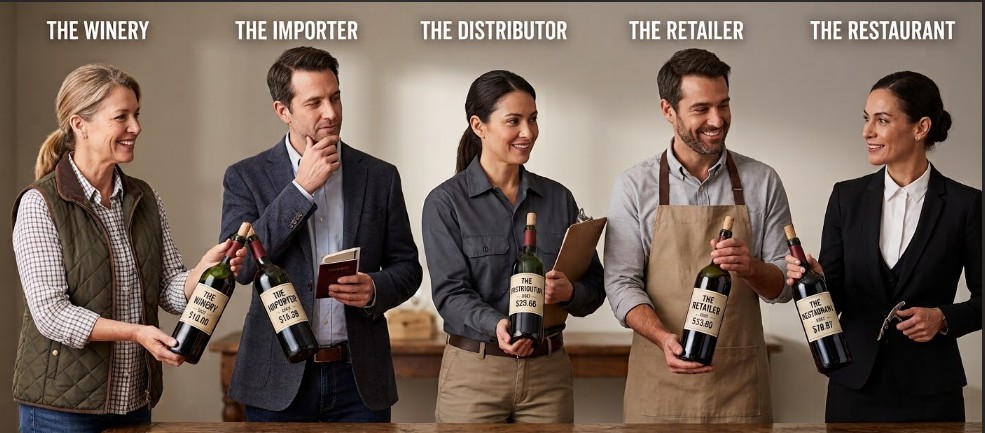
Here is a step-by-step breakdown of the tiers and what they in general make on each sale. It maps each step of the chain horizontally for a wine that costs them $5.00 to produce. It's general and one size doesn't fit all...but it is very close to what most of the industry use.
- The Winery: $5.00 cost @ 50% margin = $10.00 price to Importer
- The Importer: $10.00 cost @ 35% margin = $15.38 price to Distributor
- The Distributor: $15.38 cost @ 35% margin =$ $23.66 price to Retailer or Restaurant
- The Retailer: $23.66 cost @ 30% margin = $33.80 price
- The Restaurant: $23.66 cost@ 70% margin = $78.87 price
Of course there are still great deals to find. You just have to search.
Big Box and Major retailers can direct ship (Costco, Total Wine and other retailers and even some restaurant groups have been doing this for years).
Other svvy Indy retailers and restaurants make their long time relationships into agreements on volume over time and keep pricing under control and serve their customers well.
Some even have wineries develop private labels and utilize the same process for import and US products, again paying less on agreed volume purchases.
Some savvy wine venues still show great value...some examples : Visit any Columbia Restaurant in Florida. They understand pricing and show great value to their customers. Same with Indies like Tim Varan in Orlando who has years of contacts with great wineries around the world, knows his customers and what they want...and expect.
Bottom line is that US laws set up the cascading pricing for wine (and spirits), and now that you understand the process, you can find value and see who really offers the consumer a good deal.